For 19 years it only went up. Draw what you think happened next.
Scroll ↓
The decade that vanished in two years
For two decades the world got steadily better at staying alive. Then COVID-19 erased nearly a decade of progress — but so unevenly that the single global number hides almost everything that actually happened.
A Data2Story analysis · WHO Global Health Observatory, 2000–2021
The reversal
The decade that vanished in two years
For the first time in over half a century, the world went backwards. Global life expectancy at birth fell from its all-time peak of 73.12 years in 2019 to 71.37 by 2021 — a drop of 1.75 years, with the slide accelerating in the second year. The 2021 figure is the level the world last passed around 2012. Roughly nine years of progress, gone in two.
What makes the reversal so jarring is the backdrop it interrupted. From 2000 to 2019, global life expectancy climbed 6.35 years, from 66.77 to 73.12, without a single down year anywhere in that 19-year stretch. The line only ever went up — until it didn't.
A long climb, then a sudden break
Global (World) life expectancy at birth, TOTAL, 2000–2021. Hover for exact values.
Pitch = life expectancy; each note is one year, 2000 → 2021. The final two descending notes are the COVID drop. As each note plays, its point on the chart pulses.
Source: WHO GHO life expectancy at birth (ana_03, ana_04). The 2019→2021 segment is drawn in alarm-orange; the dashed line marks the 71.31 level the world last held in 2012.
−1.75 yrsglobal life expectancy lost 2019–2021 — roughly nine years of progress, gone in two
One caution before going further: this is period life expectancy, a snapshot of a single year's mortality conditions, not a forecast of how long a baby born in 2021 will actually live. The 2021 number does not predict a shorter life for today's newborns; it measures how deadly the world was in that one pandemic year. That distinction is what makes the whole story possible to tell honestly.
Three elderly women in Nikko, Japan — the longest-lived country in the data. These averages are about how long people actually live. Photo: Adam Jones / Wikimedia Commons, CC BY-SA 2.0.
The long climb
A long climb, powered by the poorest
To understand what COVID took away, you first have to understand whose progress it was. The pre-pandemic rise was not a story of rich countries getting marginally richer in years. It was a story of catch-up.
The fifteen largest life-expectancy gains from 2000 to 2019 were all sub-Saharan African. Rwanda gained 20.9 years, climbing from 46.9 to 67.8; Burundi added 20.0, Malawi 18.6, Ethiopia 18.1. These reflect recovery from catastrophe — the aftermath of conflict, falling child mortality, and above all the rollout of antiretroviral therapy after HIV/AIDS had gutted life expectancy across the region.
The floor rose fastest: biggest changes, 2000–2019
Life expectancy in 2000 → 2019 per country (dumbbell), sorted by gain. Hover for start, end, and change.
Source: ana_18. Gainers in cool blue, the few pre-COVID regressors (Syria, Venezuela) in alarm-orange.
At the regional level the same pattern holds: WHO's Africa region surged 11.2 years over 2000–2019, more than double the gain of Europe (5.7) or the Western Pacific (5.5). The world's average rose because its floor rose far faster than its ceiling.
HIV era and back: four southern African trajectories
Life expectancy, TOTAL, 2000–2021. Each panel dips to its mid-2000s HIV trough, recovers as antiretroviral therapy scales up, then takes a fresh 2021 COVID nick.
Source: ana_19. Secondary color within this section.
The income gradient tells it most cleanly. The gap between high- and low-income economies shrank from 23.92 years in 2000 to 16.69 in 2019, as low-income economies gained 10.6 years while high-income ones gained just 3.4. Progress was real, and it was disproportionately the progress of the poor.
The income gradient, narrowing
Four World Bank income groups, 2000–2021. The shaded wedge between the highest and lowest lines closes from 23.92 years (2000) to 16.69 (2019).
Source: ana_15. The closing band is the convergence.
The chasm
One number, thirty-three years apart
However fast the floor was rising, it was rising from very far below. In 2021 the distance between the longest- and shortest-lived countries was 32.98 years — Japan at 84.46, Lesotho at 51.48. The "world average" of 71.37 is the midpoint of a chasm, not a description of any real place.
The top of the table is a cluster of high-income East Asian and Western European states: Japan first, then Singapore (83.86), Republic of Korea (83.80), Switzerland (83.33), Australia (83.10). The bottom is almost entirely sub-Saharan African and largely HIV-scarred: Lesotho last, just below the Central African Republic (52.31), Somalia (53.95), and Eswatini (54.59).
The 33-year chasm, on a map
Life expectancy at birth, TOTAL, 2021. Hover or tap a country for its value and uncertainty band.
Shading by life expectancy · low ▮ → high ▮
Lesotho 51.48Japan 84.46
32.98 years separate Japan (84.46) from Lesotho (51.48) in 2021 — mean 71.23, median 72.19, SD 7.15 across 183 countries (ana_10). Toggle "certainty" to see that the lowest figures carry the widest uncertainty bands (r = −0.81).
But a low number does not mean what it sounds like. Life expectancy at birth is pulled down sharply by deaths in the first years of life, so much of this gap historically reflected child survival rather than how long adults live — a low figure does not mean few people reach old age. The chasm is real; the simplest interpretation of it is not.
Top 15 and bottom 15, with uncertainty bands
2021, TOTAL. The bottom-panel bands are visibly wider than the tight top-panel dots — the lowest figures are the least precisely measured (ana_12).
Source: ana_08 (top, cool) & ana_09 (bottom, warm). The empty middle is the 33-year chasm.
Japan
84.46
top
Switzerland
83.33
near top
Chad
59.09
near bottom
Lesotho
51.48
bottom
The chasm's endpoints. Flags: Wikimedia Commons, public domain.
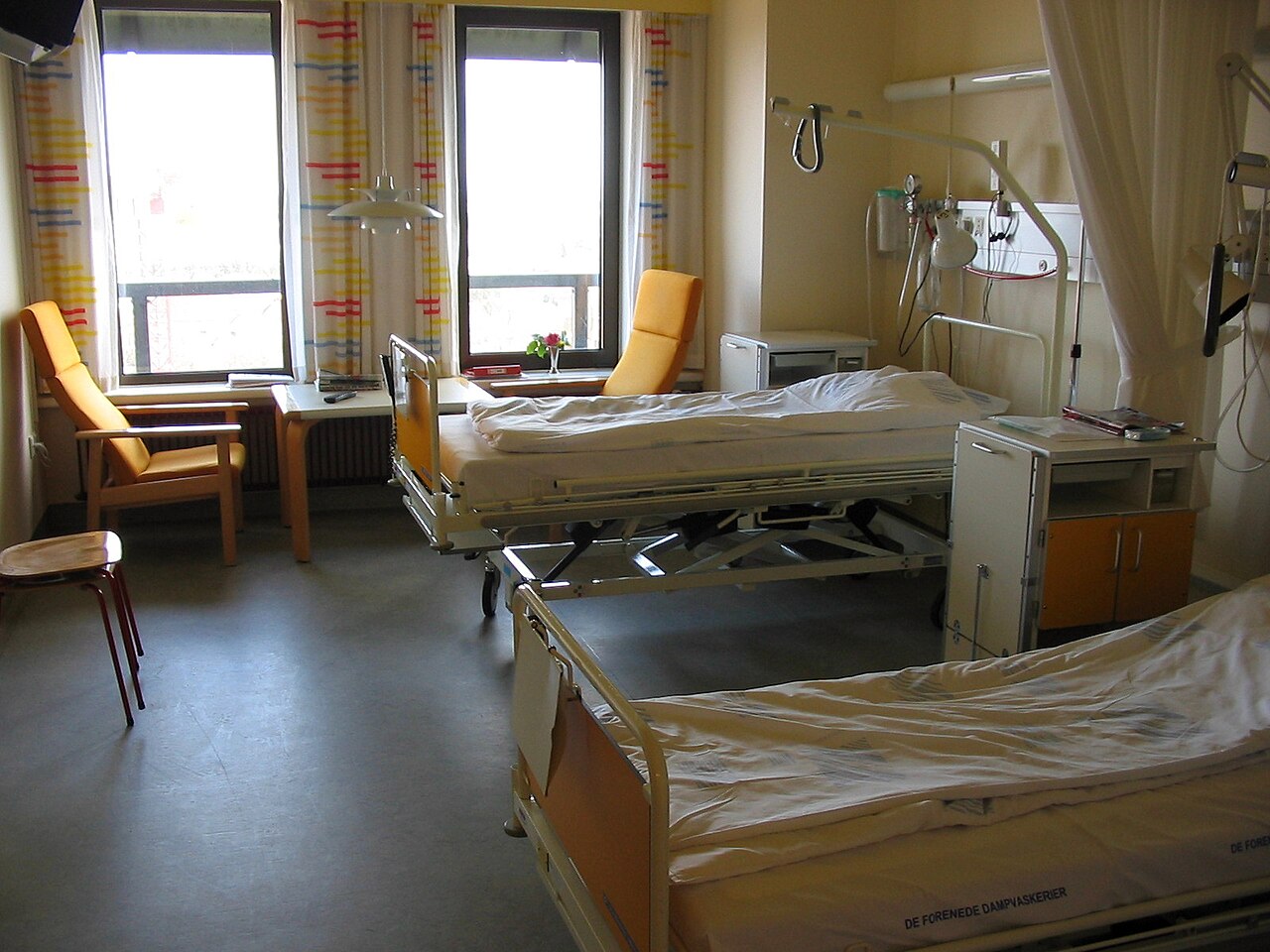
A modern hospital room — the health-system capacity whose uneven collapse produced wildly different regional COVID tolls. Photo: Tomasz Sienicki / Wikimedia Commons, public domain.
The turn
The average that lied
Return now to the 1.75-year global drop — and watch it dissolve. Between 2019 and 2021, South-East Asia lost 3.01 years and the Americas 2.96, while the Western Pacific lost 0.07. The hardest-hit regions cratered roughly forty times more than the one that held steady. The single global figure is an average of experiences that have almost nothing in common.
COVID's reach, by WHO region
Life expectancy lost, 2019→2021. The dashed line marks the global −1.75-year average.
Source: ana_14. South-East Asia and the Americas tower over the barely-moved Western Pacific.
At the country level the dispersion is starker still. Bolivia lost 7.51 years, more than four times the global drop; Peru lost 6.63, Mexico 5.00, the United States 2.37. Meanwhile 28 countries actually gained ground over the same window — Australia rose 0.46, New Zealand 0.39 — so the same two years that gutted the Andes barely touched the South Pacific.
−2.36 vs −0.55 yrslower-middle-income economies took the worst hit; the poorest, low-income economies lost the least — a counterintuitive pattern that likely owes as much to younger populations and thinner surveillance as to real resilience
COVID losses by country: Bolivia −7.5 to the gainers
Change in life expectancy, 2019→2021. Losers (warm) left of zero; the paradoxical gainers (cool) right of zero.
Source: ana_20. Syria's +3.26 is flagged as a likely modeling/recovery artifact on an already war-depressed base, not pandemic resilience.
The income pattern is the most counterintuitive of all: the loss was largest for lower-middle-income economies (–2.36 years) and smallest for the poorest, low-income economies (–0.55). The "great reversal" was concentrated in the middle of the world's income distribution, not at the bottom — a pattern that likely owes as much to younger populations and thinner surveillance as to any real resilience.
The constant
One advantage that barely moved
Against all this turbulence, one gap stayed almost perfectly still. In 2021 women outlived men in 182 of 183 countries; the lone exception is Israel, where men edge women by 0.29 years. The advantage is widest across the post-Soviet belt — Belarus at 10.07 years, with Latvia, Lithuania, Ukraine and Russia close behind — a pattern long tied to male alcohol, tobacco, and external-cause mortality.
In 2021, women outlived men in 182 of 183 countries. In the one exception, men edged ahead. Which country?
The answer is Israel — the sole reversal, where men live 0.29 years longer than women (82.4 vs 82.1). Everywhere else, women still come out ahead. Here is the full picture, widest gap to narrowest ↓
The female advantage, widest to narrowest (2021)
Each row is one country: male dot → female dot, connector length = the gap. The post-Soviet belt anchors the wide end; Israel sits alone with a reversed connector.
Source: ana_07. Female dot in cool blue, male dot muted.
Globally the gap has barely budged in two decades: 4.83 years in 2000, 5.07 in 2021, never straying outside a 4.82-to-5.41 band. Even COVID, which scrambled almost every other number in this dataset, left the female advantage essentially untouched. Some structures bend; this one didn't.
The gap that wouldn't move: ~5 years for two decades
Global female−male gap, selected years. The shaded band is the 4.82–5.41 envelope the gap never leaves — including straight through COVID.
Source: ana_06. The visual point is the non-event.
The long view
The gap was closing — and may be again
Step back to the longest view and the pandemic shrinks to a blip. The spread of life expectancy across countries narrowed steadily for two decades — the standard deviation across 183 nations fell from 9.84 years in 2000 to 7.29 in 2019 — as the poorest places gained fastest. COVID nudged it the other way, but only barely: dispersion ticked from 7.29 up to 7.15 by 2021. The long story is convergence; the pandemic was a small divergent interruption, not a reversal of the trend.
Two decades of convergence, one pandemic blip
Standard deviation of life expectancy across 183 countries, 2000–2021. Falling SD means countries growing more alike.
Source: ana_17. The 2021 uptick (7.09→7.15) is deliberately tiny against the −2.55 long-run convergence.
One last reminder of how to read every number here. In 2010 a single earthquake drove Haiti's life expectancy from 60.7 to 40.0 — and back to 61.1 the very next year. A 21-year plunge that vanished in twelve months is the clearest proof that period life expectancy is a snapshot of one year's mortality, not a verdict on a life. The same logic applies, more gently, to 2020 and 2021: a deep wound in the record, not necessarily a permanent loss of years for anyone alive.
Haiti 2010: a 21-year hole that closed in a year
Life expectancy, TOTAL, 2000–2021. One violent spike to 40.0 in the earthquake year, snapping right back to 61.1 in 2011.
Source: ana_22. The clearest illustration that period life expectancy is a one-year mortality snapshot — the same logic that should temper how we read 2020–2021.
So the honest closing question is not whether the world recovers its lost decade — early signs and the underlying convergence suggest it will — but whether we keep reading "global life expectancy" as a single shared fact, when the data has just spent two pandemic years proving it was never that at all.